
Brass Hex Insert
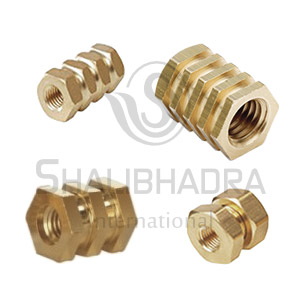
Complete Technical Guide
A brass hex insert is a precision brass component with a hexagonal external profile and, in many designs, an internal threaded hole. It provides a durable screw connection in plastic, furniture, electrical components and other assemblies.
The term hex insert can refer to several different designs. The correct dimensions, installation method and manufacturing process depend on which type you need.
Types of brass hex inserts
A. Hexagonal brass threaded insert
Six-sided exterior • Internal female thread
The hexagonal shape resists rotation when held in a matching hexagonal pocket or cavity. Used in mechanical assemblies, housings and fixtures.

Moulded into plastic components
Installed in the mould before injection, with external features designed to retain it in the finished plastic part. The hexagonal body can help prevent rotation if the mating cavity is properly designed.

Installed into a prepared hole or pocket
Uses a specified interference fit, external grooves or a hexagonal profile to provide retention. Suitability depends on the host material and installation force.

Typical dimensions and thread specifications
The dimensions below are illustrative starting points for design discussions, not verified dimensions for a specific manufacturer’s product.
| Parameter | Common design options |
|---|---|
| Internal thread | M3, M4, M5, M6, M8 and larger |
| External profile | Hexagonal, knurled, grooved or barbed |
| Material | Free-machining brass or specified low-lead brass |
| Thread standard | Metric ISO or Unified inch thread |
| Finish | Natural brass, nickel plating, tin plating or another specified finish |
| Manufacturing | CNC turning, automatic lathe, milling, drilling and tapping |
For example, an M6 insert normally has an internal thread with a nominal diameter of 6 mm and a standard coarse pitch of 1.0 mm. The external hex size and overall length must be specified separately.
Important design features
Determines screw compatibility, thread engagement and resistance to stripping. Check the thread with the correct GO/NO-GO gauge.

Controls the size of the hex pocket, tool or mating component. Across-corners dimension is larger than across-flats dimension.

Knurls, grooves and barbs can improve grip in compatible host materials. The best geometry depends on whether the insert is moulded in, pressed in or mechanically retained.

4. Manufacturing process for brass hex inserts


-
Raw material selection: Choose brass rod or hexagonal bar stock of the correct alloy and size.
-
Cutting and facing: Cut the blank and prepare the end face.
-
Turning or milling: Machine the body, shoulders and external profile as required.
-
Drilling: Produce the internal bore.
-
Tapping: Cut the internal thread to the specified standard.
-
Grooving or knurling: Add external retention features where required.
-
Deburring and finishing: Remove sharp edges, clean the part and apply any specified coating.
-
Inspection: Check the thread, dimensions, hex flats and functional retention.
Production tip: If the part is fundamentally hexagonal, starting from hexagonal bar stock may reduce machining time. If it has a round body with a hexagonal head, round bar and secondary milling may be more appropriate. The most economical choice depends on the drawing and production volume.
Brass grades and material selection
| Brass grade | Typical consideration |
|---|---|
| CuZn39Pb3 | Good machinability for many turned components; lead content must be acceptable for the application |
| C3604 | Common free-machining brass grade in some Asian markets |
| CW614N / CZ121 | Machinable brass grades; confirm the exact standard and applicable composition |
| Low-lead brass | Consider when drinking-water, consumer-product or regulatory requirements restrict lead |
These grades are not automatically interchangeable. Specify the governing material standard, chemical composition and applicable regulatory requirements in the purchase order.
Quality inspection
A production inspection plan should include:
-
Internal thread diameter, pitch and gauge acceptance.
-
Hex across-flats dimension and dimensional tolerances.
-
Overall length, shoulder dimensions and concentricity.
-
Burrs, cracks, surface damage and plating quality.
-
Pull-out and torque-out tests for inserts installed in plastic or other host materials.
-
Material certification when required.
For inserts used in plastic, the actual resin, wall thickness, hole geometry and installation process strongly affect performance.
Related Product
Explore the Product
Discover more details about the product featured in this article.
View Product