
Brass Rotational Insert
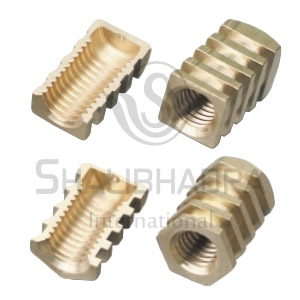
Complete Product Guide
A brass rotational insert is a precision-engineered metal insert used in plastic products manufactured through rotational moulding (rotomoulding), as well as other applications where a strong threaded mounting point is needed.
These inserts allow screws, bolts, studs, or other fasteners to be installed into a plastic component without relying on threads cut directly into the plastic.
Product appearance and design


-
Internal threads: Accept screws or bolts.
-
External anchoring geometry: Hexagonal, square, grooved, or knurled surfaces help prevent rotation or pull-out.
-
Flange or shoulder: Can help locate the insert and control its seating depth.
-
Blind or through hole: Selected according to the fastening requirement.
-
Custom body profile: Designed to match the mould, plastic wall thickness, and assembly requirements.
The exact design depends on whether the insert is installed during moulding or fitted into an existing plastic component afterward.
Applications
Used as threaded mounting or connection points in compatible moulded plastic products, depending on the insert design and sealing requirements.

For attaching covers, brackets, panels, and internal components.

Provide reusable threaded mounting points in selected plastic assemblies.

Used to mount hinges, handles, legs, brackets, and other hardware.

Types of brass rotational inserts
Closed-bottom internal thread
Features a hexagonal exterior and a threaded hole that does not pass through the entire insert. Suitable where a blind fastening point is required.
Square exterior profile
Designed to create a threaded fixing point, with the square profile helping resist rotation when properly embedded in plastic.

C. Hexagonal through insert
Thread extends through the body
Used where a bolt or threaded connection must pass through the complete insert.

Quality tests to consider
-
Thread gauge test: Verify the internal thread using suitable GO/NO-GO gauges.
-
Dimensional inspection: Check length, across-flats dimension, hole depth, and concentricity.
-
Pull-out test: Measure the force required to extract the insert from the moulded plastic.
-
Torque resistance test: Check whether the insert rotates under the specified tightening or service torque.
-
Visual inspection: Identify burrs, damaged threads, plating defects, and other surface issues.
Acceptance limits should be established from the product drawing and application requirements. Pull-out and torque performance depend on the insert geometry, plastic material, wall thickness, and moulding process.
How to choose the correct insert
Before ordering, confirm these six points:
-
Thread size, such as M6, M8, or M10.
-
Insert type: hex blind, square blind, or hex through.
-
Overall length and external dimensions.
-
Brass grade and required corrosion resistance.
-
Plastic material and wall thickness.
-
Required pull-out force, torque resistance, and quantity.
For water tanks or fluid-handling products, also consider sealing, fluid compatibility, and any applicable potable-water requirements.
Related Product
Explore the Product
Discover more details about the product featured in this article.
View Product