
Brass Inserts
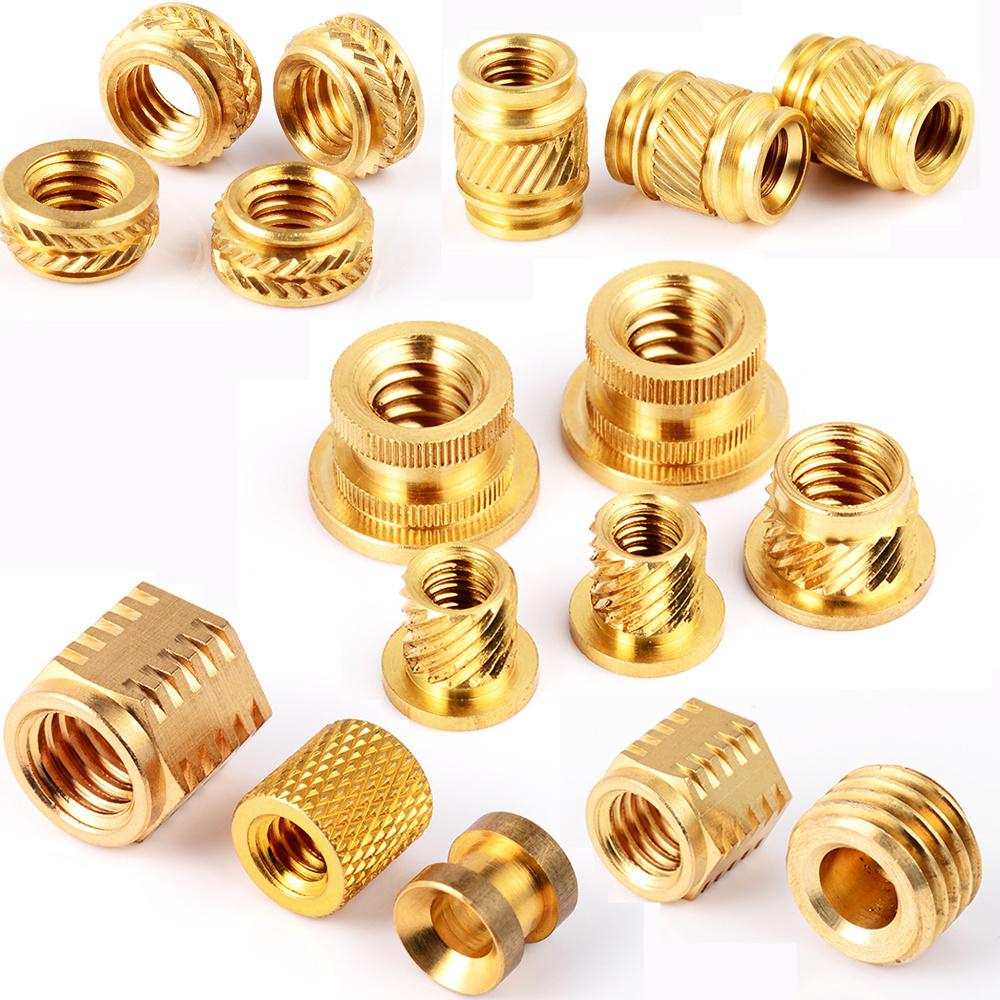
Detailed Product Description


Introduction to Brass Inserts
Brass inserts are precision-engineered threaded fastening components manufactured from high-quality brass alloys. They are specially designed to create strong, durable, and reliable threaded connections in different materials, including plastic, wood, rubber, composite materials, and certain metal assemblies.
Brass inserts are widely used in manufacturing industries because they provide excellent machinability, good corrosion resistance, dimensional accuracy, and reliable fastening performance.
They are particularly useful in plastic components where directly creating internal threads in the plastic may result in thread damage, stripping, or reduced fastening strength. By incorporating a brass insert, manufacturers can create a durable metal-threaded connection that allows repeated screw installation and removal.
Brass inserts are available in different shapes, sizes, thread configurations, and surface designs to meet specific industrial requirements. Depending on the application, they can be installed using heat, ultrasonic vibration, moulding, pressing, expansion, or screw-in methods.
Detailed features of brass inserts

Specially machined knurling patterns provide mechanical grip and improve resistance to rotation and pull-out when installed in compatible materials.

Accurately machined internal threads provide proper screw engagement, reliable fastening, and consistent assembly performance.

Multiple Body Configurations
Available in round, hexagonal, square, flanged, slotted, and customized profiles according to application requirements.

High Dimensional Accuracy
Precision turning, drilling, tapping, and finishing processes help maintain dimensional consistency and assembly compatibility.
Advantages of brass inserts
-
Excellent machinability: Brass can be efficiently machined using automatic lathes and CNC turning machines.
-
Corrosion resistance: Provides good resistance to corrosion in many normal industrial environments.
-
Strong threaded connection: Offers a durable metal thread compared with threads formed directly in many plastic materials.
-
Electrical conductivity: Suitable for selected electrical and electronic applications.
-
Thermal conductivity: Helps transfer heat in applications requiring thermal contact.
-
Reusable fastening: Supports repeated screw installation and removal when correctly designed and installed.
-
Custom manufacturing: Can be produced in different dimensions, profiles, and thread specifications.
-
Smooth surface finish: Can provide an attractive natural brass appearance or additional plated finishes.
Industrial applications

Plastic injection moulding
Electronic housings, plastic enclosures and moulded assemblies.

Plumbing industry
Threaded connections in compatible PPR and other plastic pipe fittings.

Furniture industry
Furniture connectors, mounting points and assembly hardware.

Automotive industry
Plastic housings, brackets, panels and fastening assemblies.

Electrical industry
Switchgear, electrical fittings and selected terminal assemblies.

Industrial machinery
Mounting components, mechanical assemblies and equipment enclosures.
Manufacturing capabilities and customization
Brass inserts can be manufactured according to customer drawings, technical specifications, and sample requirements.
| Manufacturing parameter | Available options |
|---|---|
| Material | Brass alloys |
| Material grades | CW614N, CW617N, C36000, IS 319, as specified |
| Thread sizes | M2 to M20 and customized |
| Thread types | Metric, UNC, UNF, BSP, NPT |
| Body shapes | Round, hexagonal, square, flanged |
| Surface finish | Natural brass, polished, nickel plated, tin plated |
| Manufacturing | CNC turning, automatic lathe, drilling, tapping |
| Packaging | Bulk, customized, industrial packaging |
Final specifications depend on the product design and application.
Quality control and inspection
Quality assurance is important for ensuring consistent product performance.
-
Raw material grade verification.
-
External diameter and length inspection.
-
Internal thread inspection using GO/NO-GO gauges.
-
Knurling and external profile inspection.
-
Surface finish and visual inspection.
-
Installation, pull-out, and torque testing where required.
-
Batch-wise dimensional quality checks.
Related Product
Explore the Product
Discover more details about the product featured in this article.
View Product